
Here’s something that catches almost every new mum off guard…
You think “exercise after birth” means getting back to the gym, fitting into your old jeans, or doing some kind of proper workout.
But in those first six weeks?
That’s usually the wrong way to look at it.
Walking to the letterbox counts.
Learning how to get out of bed without feeling like your insides are going to fall out counts.
Reconnecting with your pelvic floor counts.
Finding a feeding position that doesn’t leave your back screaming counts.
That’s the difference between bouncing back and actually recovering properly.
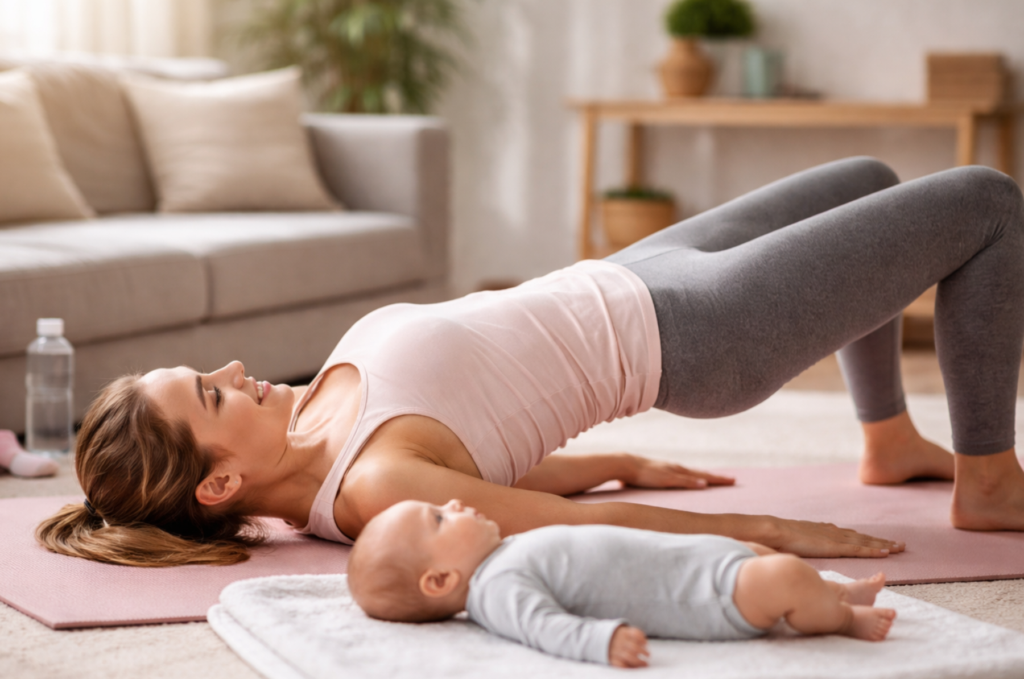
What Exercise After Birth Actually Means
In the first six weeks, exercise is less about fitness and more about recovery.
Let that sink in for a second.
If you’ve had an uncomplicated birth, official guidance says you can usually start gentle pelvic floor and abdominal exercises in the first few days after birth, and you can begin gentle walking when you feel ready.
For most women, higher impact exercise, gym sessions, and group classes should wait until after the 6-week check – and longer if recovery has been more complicated.
If you had a caesarean birth, healing usually takes at least 6 weeks, and activity often needs to progress more slowly.
Here’s where many women get stuck:
They swing between two extremes.
Either they do too much because they’re desperate to feel normal again.
Or they do almost nothing because they’re terrified of making things worse.
Usually, the best path is in the middle:
Enough movement to support circulation, posture, breathing, pelvic floor recovery, and confidence – without loading healing tissues too aggressively.
The First 7 Days: Start With Recovery, Not Workouts
In the first week, your body is still dealing with bleeding, soreness, sleep disruption, feeding, and the physical impact of labour or surgery.
The goal is not “getting back into shape.”
The goal is helping your body settle and gently wake back up.
Here’s what that usually looks like:
Days 1 to 7: Breathing, pelvic floor connection, short walks around the house, getting out of bed well, standing tall, gentle abdominal activation if comfortable
Weeks 2 to 6: Slightly longer walks, more consistent pelvic floor and abdominal work, light daily movement, better lifting and feeding mechanics
After 6 weeks: More formal exercise may be appropriate after review, depending on birth, symptoms, healing, and medical advice
And here’s the thing:
That timeline is not a competition.
Some women feel ready to walk outside in the first few days. Some need more time because of tears, stitches, blood loss, pelvic pain, back pain, or a difficult birth.
If movement causes pain, pressure, or a pulling sensation, scale back and get advice.
There’s no prize for pushing through when your body is telling you to slow down.
Weeks 2 to 6: Build Gentle Movement Back In
By weeks 2 to 6, many women are ready for a bit more structure.
But this is still early recovery.
It’s not the stage for sit-ups, high-intensity circuits, running, or “fat-burning” workouts.
We advise avoiding heavy weights, sit-ups, and high-intensity aerobic exercise such as running in the early months after birth, and to wait until after your 6-week check before going back to the gym, group exercise, or personal training.
What usually helps in this window is consistency:
- A short walk most days
- A few rounds of pelvic floor and lower tummy connection
- Better posture while feeding
- More awareness of how you lift the baby, the capsule, or the laundry basket
Not sexy. Not Instagram-worthy.
But incredibly effective.
Everyday Movements That Count as Exercise After Birth
In the early weeks, the way you move through the day often matters more than one dedicated exercise session.
Let’s talk about what that actually looks like.
Getting Out of Bed
Rolling onto your side first, using your arms, and then pushing yourself up usually places less strain on the abdominal wall than trying to sit straight up.
This is especially helpful if your tummy feels weak or you’ve had a caesarean birth.
We suggest practising abdominal bracing during movements like getting in and out of bed.
It sounds simple, but it makes a huge difference.
Lifting and Carrying Your Baby
Before you lift, gently tighten through the lower tummy and pelvic floor, keep your back fairly straight, and bring the baby close to your body.
After caesarean birth, official guidance says to avoid lifting anything heavier than your baby for the first 6 weeks.
Even after a vaginal birth, repeated awkward lifting can wind up a sore back or pelvic floor quickly.
And let’s be honest – you’re lifting your baby constantly.
So getting this right matters.
Walking
Walking is one of the most useful early exercises after birth because it supports circulation, mood, and confidence without needing equipment or childcare.
Start small.
That might mean a few minutes around the house, then to the mailbox, then around the block.
We recommend building up gradually and aiming for a 30-minute walk each day if you can.
But “if you can” is the key phrase here.
Some days, five minutes is a win.
Feeding Posture and Upper Back Support
Feeding a baby can mean long periods in one position, rounded shoulders, and a sore upper or lower back.
Use pillows. Bring the baby up to you instead of curling down. Change positions when you can.
That may not sound like exercise, but posture management is part of early recovery because it changes the load going through your neck, shoulders, abdominal wall, and spine.
Plus, when you’re feeding for hours every day, those small adjustments add up fast.
5 Early Exercises That Are Often a Good Place to Start
1. 360 Breathing
Breathe into your ribs and lower belly, then exhale slowly.
This helps reconnect your breathing muscles with the abdominal wall and pelvic floor.
It sounds almost too simple to matter, but it’s foundational.
2. Gentle Pelvic Floor Squeeze and Lift
Think about stopping wind and gently stopping urine flow, then relax fully.
We support regular pelvic floor muscle training. Gentle pelvic floor work can start in the first few days after birth if comfortable.
The key word is gentle.
3. Lower Tummy Connection
Gently draw the lower tummy in toward the spine while breathing normally.
This is called abdominal bracing and we suggest using it during daily movements.
4. Short Gentle Walks
A lap of the house counts. So does five minutes with the pram.
You’re building tolerance, not trying to prove anything.
5. Posture Reset
Sit tall, soften your ribs, relax your shoulders, and gently stack your head over your body.
Do this throughout the day – especially while feeding.
A Simple 3-Step Early Recovery Plan
Step 1: Reconnect
Start with breathing, pelvic floor awareness, and gentle lower tummy support.
This is about waking your body back up, not pushing it.
Step 2: Restore Daily Movement
Practise getting out of bed, walking, lifting the baby, and feeding with less strain.
Small changes in how you move can make a massive difference in how you feel.
Step 3: Build Gradually
Add time and walking distance slowly, based on symptoms, energy, and healing.
Not based on what your friend is doing or what you see on social media.
This is often the safest way to start.
The early goal is not to train hard. It’s to get your body feeling safe, supported, and capable again.
What to Avoid Doing Too Soon
In early recovery, more is not always better.
If you’ve had a vaginal birth with stitches or a perineal tear, high-impact activity, sit-ups, and heavy lifting can place extra pressure on healing tissues.
Avoid heavy weights, sit-ups, and high-intensity aerobic activity early on.
Perineal tear guidance advises avoiding lifting, sit-ups, and high-impact exercise while healing.
Wait until after the 6-week postnatal check before starting high-impact exercise like running or aerobics.
That doesn’t mean complete bed rest.
The better question is:
“What can I do without increasing pain, heaviness, bleeding, or pressure?”
That’s your guide.
When Exercise After Birth Doesn’t Feel Right
A bit of soreness and fatigue can be normal.
Feeling worse every day is not.
Talk to your doctor, midwife, maternal child health nurse, or women’s health physiotherapist if exercise or daily movement brings on:
- Pelvic heaviness
- Leaking
- Increasing bleeding
- Scar pulling
- Strong abdominal doming
- Significant back pain
- A sense that something just feels wrong
We recommend getting advice if pelvic floor symptoms haven’t improved, especially beyond the early months.
Get urgent medical help if you have:
- Heavy bleeding that soaks a pad quickly
- Fever
- Increasing wound pain
- Chest pain
- Shortness of breath
- Severe headache
- Calf swelling
- Loss of bladder or bowel control
Postpartum care is now viewed as an ongoing process, not just a single 6-week visit, and we recommend contact with a maternal care provider within the first 3 weeks postpartum.
Your body just did something incredible.
It deserves proper care and attention.
How Women’s Health Physiotherapy Can Help in the Early Stage
Sometimes the hardest part is not knowing what’s safe.
You want to do the right thing, but you’re not sure what that is.
That’s where women’s health physiotherapy can help.
An early assessment can guide you on pelvic floor activation, abdominal support, posture, lifting, back pain, scar healing after caesarean birth, and the right next step for your body – not someone else’s body on social media.
At Get Better Physiotherapy in Regents Park, we help new mums make sense of early recovery.
That might mean giving you a simple home plan, helping you manage back or pelvic pain, checking how your tummy and pelvic floor are working, or helping you feel more confident about the move from “just had a baby” to “ready to do a bit more.”
Most women tell us they feel this huge sense of relief after their first appointment.
Not because everything is “fixed.”
But because they finally have clarity.
They know what to do, what to avoid, and what’s actually normal.
Start With What Counts
Exercise after birth doesn’t need to start with a workout.
It starts with walking, breathing, posture, pelvic floor work, and the everyday movements that help you care for yourself while caring for your baby.
Your body did something incredible.
Now let’s help it recover properly.
Your Quick-Start Checklist: What to Do Right Now
If you’re reading this in those first 6 weeks and wondering “okay, but what do I actually DO today?” – here’s your simple action plan:
Today (Days 1-7):
- [ ] Practice getting out of bed the right way (roll to side first, then push up with arms)
- [ ] Try 3-5 gentle pelvic floor squeezes (just a few, not a marathon)
- [ ] Take a short walk around your house or to the front door
- [ ] Check your feeding posture – use pillows to bring baby to you
- [ ] Do 5 slow, deep belly breaths
This Week (Weeks 1-2):
- [ ] Walk to the letterbox or around the block (even 5 minutes counts)
- [ ] Practice pelvic floor exercises 2-3 times daily (gentle squeezes, then fully relax)
- [ ] Work on your posture while feeding and holding baby
- [ ] Gently engage your lower tummy before lifting baby or getting up
- [ ] Notice if anything causes pain, pressure, or heaviness – and scale back if it does
This Month (Weeks 2-6):
- [ ] Build up to 15-30 minute walks most days
- [ ] Continue daily pelvic floor work
- [ ] Practice abdominal bracing during daily movements
- [ ] Book your 6-week postnatal check
- [ ] Consider booking a women’s health physio assessment if anything doesn’t feel right
Red Flags – Get Help If You Notice:
- [ ] Leaking urine that’s not improving
- [ ] Pelvic heaviness or bulging sensation
- [ ] Back pain that’s getting worse
- [ ] Abdominal doming or separation
- [ ] Increased bleeding with activity
- [ ] Anything that just feels “wrong”
Ready for More Support?
If you want a personalized plan instead of guessing, book a women’s health physiotherapy appointment with Get Better Physiotherapy in Regents Park.
Early support can make recovery feel clearer, calmer, and far less overwhelming.
Because you don’t have to figure this out alone.
And you definitely don’t have to guess.
Leave A Comment