
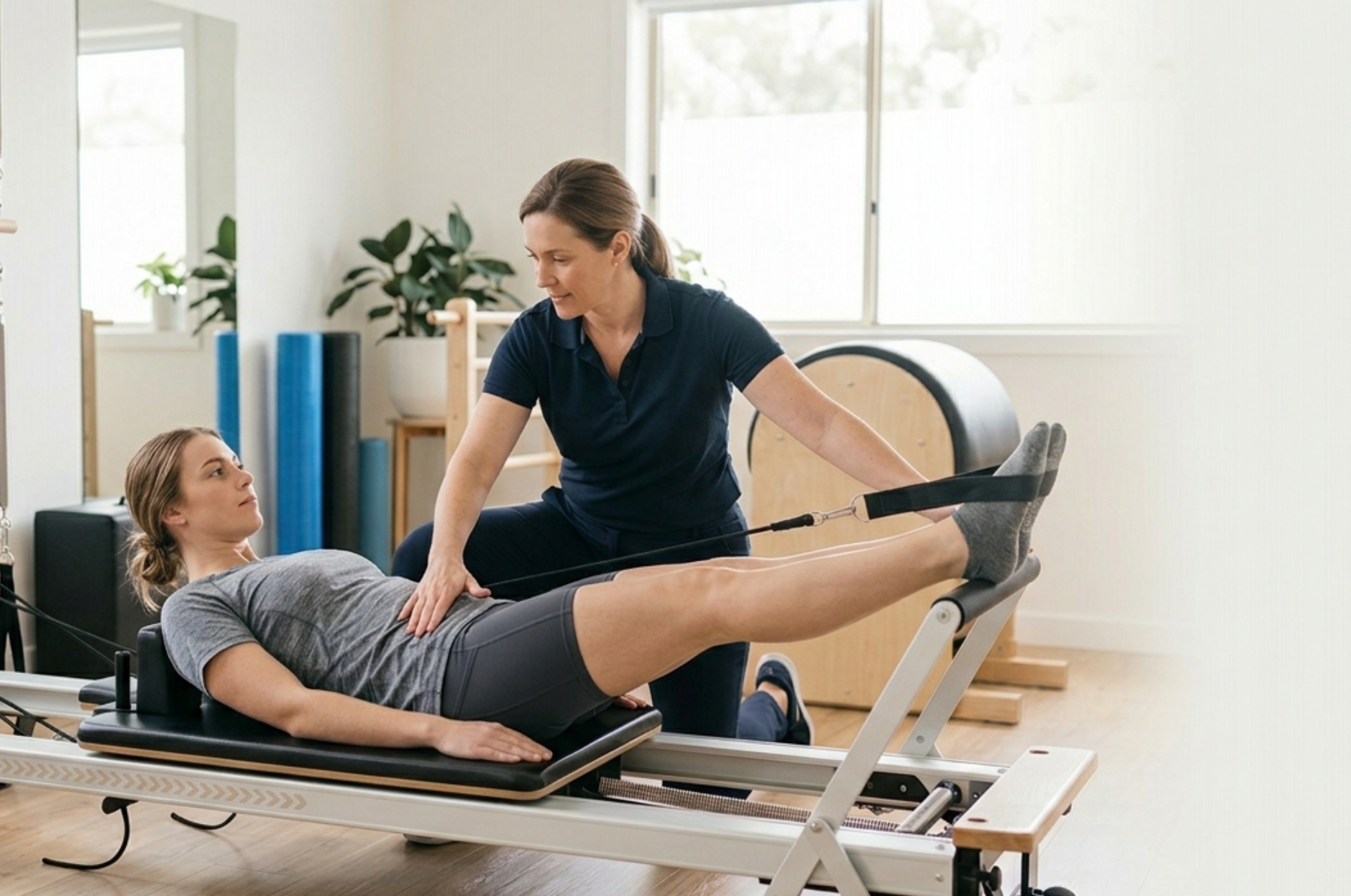
Cleared by your physio but still do not trust your body? Here’s why. Your injury may be healing, but your movement patterns, load tolerance, and confidence often need more work. That is where clinical Pilates fits in.
At Get Better Physiotherapy, we use Pilates for Injury Recovery Brisbane clients actually need: structured, evidence-based, and specific to where you are in rehab right now.
If you are too injured for the gym but too strong for basic physio exercises, this is often the next step. Not because Pilates is magic.
Not because reformer machines fix everything. But because the gap between early rehab and full return to movement is where many people either stall or get hurt again.
Your body is healing right now. Make sure it is healing correctly.
When the first flare-up settles.
The stage where the swelling is down, the scar is healing, the surgeon or physio says you can do more, but normal exercise still feels like too much. The stage where one wrong move feels like it could set you back months. The stage where people stop resting, but are not yet ready for regular classes, heavy lifting, full running, or hard sport.
That is the space our clinical Pilates program is designed for.
At Get Better Physiotherapy in Regents Park, our studio-based clinical Pilates services are used as part of a broader physiotherapy and rehabilitation plan. We use reformer, mat, and targeted exercise progressions to help patients build strength, improve movement quality, and return to real life with less fear and better control.
Pilates can be used in rehabilitation settings and is commonly described as a safe and effective form of exercise that focuses on muscular balance, strength, flexibility, and control when it is matched to the person and their condition.
When do you move from physio to Pilates?
This is one of the most important questions, and it is usually the wrong way around.
You do not really “finish physio” and then suddenly “start Pilates.” In a good clinic, they overlap. Physiotherapy helps settle pain, restore mobility, manage symptoms, guide tissue healing, and begin rehab. Clinical Pilates becomes useful when you are ready for more movement repetition, more strength endurance, more control under load, and more functional progression, but still need supervision and individual modification.
You may be ready for physio-led Pilates when:
- your symptoms are more stable, even if you are not 100% pain-free
- you can tolerate basic rehab exercises, but they no longer feel challenging enough
- you need to build strength, balance, control, and conditioning before returning to full training
- you are recovering from surgery and want a safer progression than going straight back to the gym
- you have chronic pain or repeated injuries and generic classes keep flaring you up
- you want a clear bridge back to running, lifting, sport, or work tasks
The difference between physio-led Pilates and regular Pilates classes matters for injury recovery because the program should be based on assessment, your condition, and your current rehab stage, not on a general workout template.
The Australian Physiotherapy Association notes that physiotherapists may use exercises or techniques drawn from Pilates within accepted physiotherapy scope, underpinned by individualised assessment, treatment, and follow-up.
Who this is for
Our Pilates for Injury Recovery Regents Park page is built for three main groups.
The post-surgery rebuilder
You have had surgery, maybe a knee replacement, ACL reconstruction, shoulder surgery, hip surgery, or another orthopaedic procedure. You have done the early rehab. You are walking better. The wound has healed. But you are not ready to trust the joint under load, and basic exercises feel too simple now.
The sports injury comeback
You strained a hamstring, rolled an ankle, hurt your knee, irritated your back, or picked up a shoulder injury. Pain is better, but your performance is not. You do not just want to “move okay.” You want to run, lift, cut, jump, rotate, and train without feeling like your body is one awkward rep away from another setback.
The chronic pain survivor
You have tried rest, massage, random exercises, and maybe even general classes. They either did not help or made things worse. You need something gentle enough not to flare symptoms, but strong enough to change how your body handles load over time.
Sports physical therapists are specifically trained to help active people return to sport after injury or surgery and reduce the risk of reinjury through exercise and education.-
What makes clinical Pilates different from regular classes?
This is where a lot of people get caught.
Regular Pilates classes can be great for general fitness. But if you are recovering from injury, post-surgery weakness, chronic pain, or a complex movement problem, general classes may move too fast, load the wrong area, or completely miss your weak spots.
Clinical Pilates is different because:
- it sits inside a physiotherapy framework
- your program is shaped by assessment findings
- exercises are selected for your injury, body, and rehab stage
- progressions are based on control and tolerance, not just “keeping up”
- modifications can be made when symptoms change
- the goal is return to function, not just a hard workout
That is why regular gym classes keep re-injuring some people. The issue is not always that they are weak. Often, it is that their movement patterns, muscle timing, joint control, and load progression are off. Your injury healed. But your movement patterns did not. Here’s how to fix that.
What happens in a Pilates for injury recovery program?
We start with an initial assessment. That lets your physiotherapist look at the real problem, not just the old diagnosis. We assess movement, posture, mobility, strength, muscle control, pain behaviour, and the demands of the activity you want to return to.
Then we build a program around that.
Depending on your condition, your clinical Pilates rehab may use reformer machines, mat exercises, spring resistance, supported strength work, mobility drills, and functional conditioning progressions. The point is not the equipment. The point is what the equipment allows us to do safely and precisely.
You may work on:
- deep core control and trunk stability
- hip and knee strength for running, stairs, squats, and sport
- shoulder and upper body control for lifting and overhead movement
- balance, proprioception, and joint awareness
- spinal movement and posture for neck and back conditions
- endurance and conditioning for return to longer activity
- movement confidence under load
Our 3-step rehab progression
| 1. Restore Control | 2. Rebuild Strength | 3. Return to Performance |
| Settle protective patterns, improve joint control, restore awareness, and make movement feel safe again. | Build real strength, flexibility, conditioning, and load tolerance through clinical Pilates and targeted rehab. | Progress toward running, lifting, sport, work, and higher-level fitness without guessing. |
Post-surgery: where Pilates fits
After surgery, most patients do not need endless rest. They need staged rehabilitation.
In the early phase, physiotherapy usually focuses on pain, swelling, range of motion, wound healing, walking pattern, and basic muscle activation. Later, the problem changes. Now the questions become: Can the knee absorb load? Can the hip stay stable? Can the shoulder handle pushing or pulling? Can you trust the joint again?
That later phase is where Pilates often becomes useful.
For post-surgery patients, we commonly use clinical Pilates as part of rehab after procedures involving the knee, hip, shoulder, or spine, once your surgeon and physiotherapist are happy for you to progress. It allows more repetitions, more control, and more precise progression than many people manage alone.
The American Academy of Orthopaedic Surgeons notes that after injury or surgery, a well-structured conditioning program helps people return to daily activities and sport, and that strong muscles reduce stress on the knee joint. For ACL reconstruction, return to full sports participation is often based on pain, swelling, range of motion, strength, endurance, and neuromuscular control, not just time since surgery.
Sports injury: the gap between rehab and full sport
This is where many active people get frustrated.
They are no longer in the “acute injury” stage, but they still cannot trust fast changes of direction, single-leg loading, jumping, landing, heavy lifting, or longer runs. This is also where incomplete rehab can leave compensation patterns hanging around. The pain may be gone, but the weakness, stiffness, and poor control are still there.
For sports injuries, our Pilates-based rehab can help bridge that gap by improving:
- single-leg control
- trunk and pelvic stability
- landing mechanics
- rotational control
- hip, knee, and ankle strength
- shoulder blade control and upper body conditioning
- confidence before return to training
That matters for runners, field sports, gym athletes, and anyone who wants more than “you’re fine now.” Physical therapists help people regain strength, motion, and balance, return to activity, and reduce reinjury risk after common sports injuries like ankle sprains and core muscle injuries.-
Return to running, lifting, and sport
How to progress from injury to full strength without the setbacks starts with getting honest about what your body can do today.
Return to running is not just about whether you can jog without pain. It is about impact tolerance, single-leg control, cadence, load through the hip and knee, and whether symptoms stay settled after the run, not just during it.
Return to lifting is not just about whether you can deadlift a bar. It is about bracing strategy, spinal control, hip drive, confidence under load, and whether the body can repeat the pattern without compensation.
Return to sport is not just about being “allowed” back. It is about whether your body has earned the right to handle speed, fatigue, contact, direction change, and performance demands.
That is why Pilates for Injury Recovery Brisbane patients value is often not the final destination. It is the bridge. It gives you a safer place to rebuild the missing parts before you get back to full fitness, club sport, longer runs, or proper strength and conditioning.
Is it too easy?
People ask this a lot, especially those coming from gym, sports, or performance backgrounds.
No, not when it is done properly.
Clinical Pilates is not meant to be random stretching on a reformer. It can be scaled up or down based on your body, your injury, and your goals. For some patients, the hardest thing is controlling a simple movement without compensation. For others, the challenge becomes longer lever work, slower tempo, unilateral loading, stronger springs, more conditioning, and better movement quality under fatigue.
The goal is not to make it easy. The goal is to make it accurate.
What conditions can this support?
Our clinic may use clinical Pilates within physiotherapy services for a range of musculoskeletal conditions and rehab goals, including:
- post-operative knee rehabilitation
- ACL rehab and return to sport
- hip pain and hip surgery progression
- shoulder rehabilitation and postural control
- chronic back or neck pain
- spinal stiffness and lower back rehab
- sports injuries and recurring overload problems
- general deconditioning after time away from exercise
Pilates is commonly used as rehabilitation and exercise to improve muscular balance, strength, and flexibility, while physiotherapy-guided exercise is used to support recovery and safe return to activity after injury.-
Why choose Get Better Physiotherapy in Regents Park?
At Get Better Physiotherapy, our clinical Pilates and physiotherapy services are designed for real rehab, not generic exercise. We combine assessment, evidence-based exercise, hands-on physiotherapy where needed, and smart progression in a supportive studio environment.
That means:
- you are not thrown into regular group classes too early
- your program reflects your current rehab stage
- your physiotherapist can help you understand why you are doing each exercise
- your return to movement is planned, not guessed
- the focus stays on better function, stronger movement, and lower reinjury risk
If you are recovering from surgery, dealing with a sports injury, managing chronic pain, or trying to find the safest next step after physio, this page is for you.
Book Pilates for Injury Recovery in Regents Park
If you are looking for Pilates for Injury Recovery Brisbane South clients can access locally, Get Better Physiotherapy in Regents Park is here to help. Whether you are post-surgery, rebuilding after sports injuries, or stuck in that frustrating middle ground between rehab and real training, we can help you move forward with a plan that makes sense.
Book your initial assessment today to find out whether clinical Pilates is the right next step for your rehabilitation, return to running, return to lifting, or return to sport. You can also contact our clinic by phone or book online to get started.